NatureBase LivingPANELS logoNatureBase LivingPANELS logo
Knowledge base

Understanding facade greening.

How the technology works, which standards apply, which funding programmes exist and what matters in your project phase. The measured impact can be found under Impact.

Basics

Systems & terms.

The key concepts of vertical greening – briefly explained.

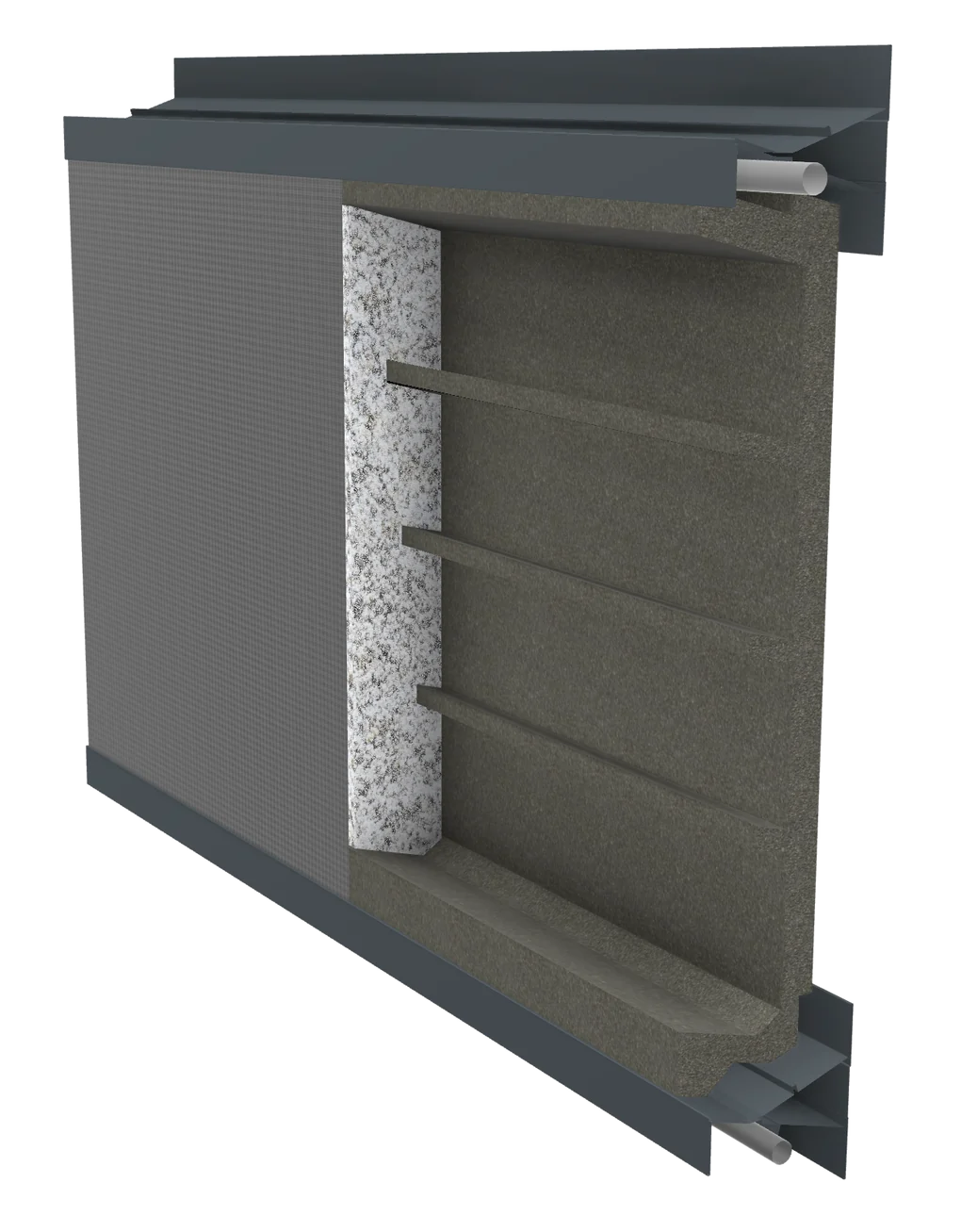
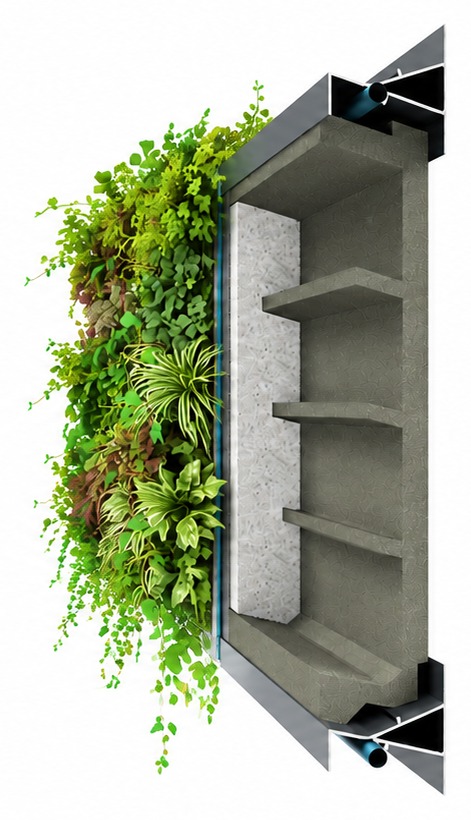
LivingPANELS module in cross-section: vegetation carrier, tray with baffle elements, plantingVegetation carrier: mineral-bound, in the tray with baffle elements
Wall-bound greening: LivingPANELS facade in detailWall-bound: curtain-wall mounted, rear-ventilated, fully green

Wall-bound vs. ground-bound

Ground-bound greening uses climbing plants rooted in the soil. Wall-bound systems such as LivingPANELS carry the plants in a vegetation carrier mounted on the wall – fully green from the start, independent of the ground.

Vegetation carrier

The core of the system: a mineral-bound, dimensionally stable carrier with around 1 litre of root space per plant. It stores water (over 45 % per litre) and remains resistant to ageing and pests.

Pre-cultivation

The modules are pre-grown for 8–10 weeks and arrive at the site fully green. The facade is green on arrival and takes effect immediately – no waiting for the first growth.

Rear ventilation

LivingPANELS are hung in front of the wall as a rear-ventilated facade. The air gap protects the building fabric and improves the building-physics performance.

ÖNORM L1136 & FLL

Planning principles for building greening: ÖNORM L1136 applies in Austria, the FLL facade greening guideline in Germany. Reaction to fire is classified according to EN 13501-1 (B-s1,d0).

HEDWIG project

Research project on the impact of building greening (BOKU/IBO). The cooling and radiation values quoted on this page were recorded at the permanent measurement site Wien Energie Simmering.

Why greening fails

Facade greening rarely fails on the idea – it fails on the system.

Three typical reasons why green facades do not deliver what they promise – and what LivingPANELS do about them.

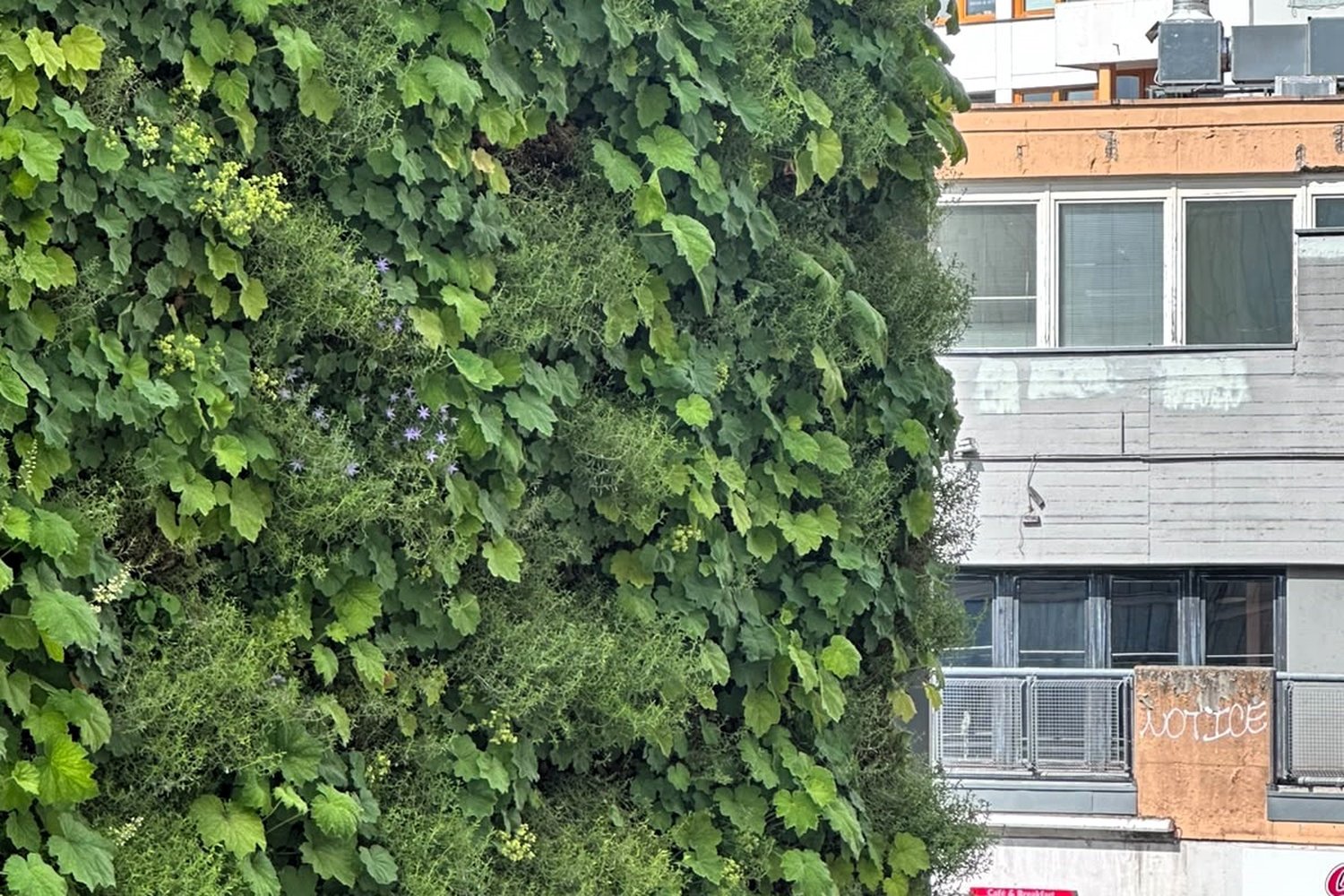
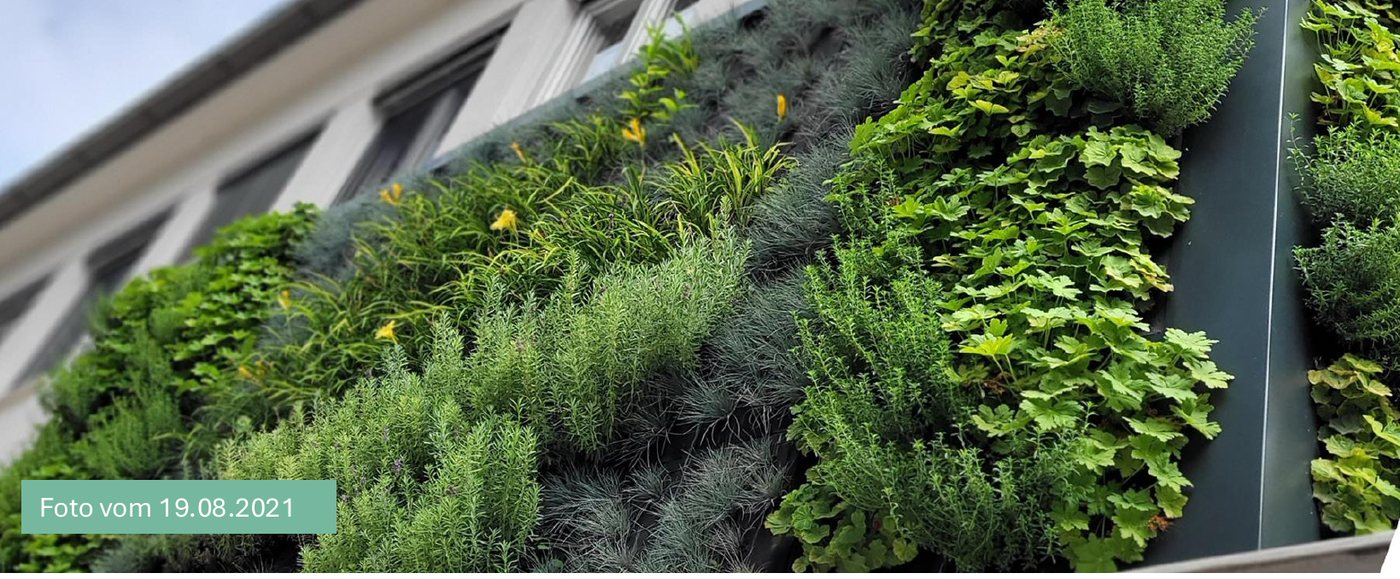
Dense perennial planting in LivingPANELS – winter-hardy, with plenty of root space

Plants that die off

Greening that becomes patchy after a few years: in a trial with textile carriers, almost 60 % of the plants died after a single late frost.¹ Too little root space, sagging substrate, ageing fleece: replanting becomes a permanent construction site.

LivingPANELS: mineral-bound, dimensionally stable vegetation carrier with around 1 litre of root space per plant and over 45 % water retention; winter-hardy operation documented.

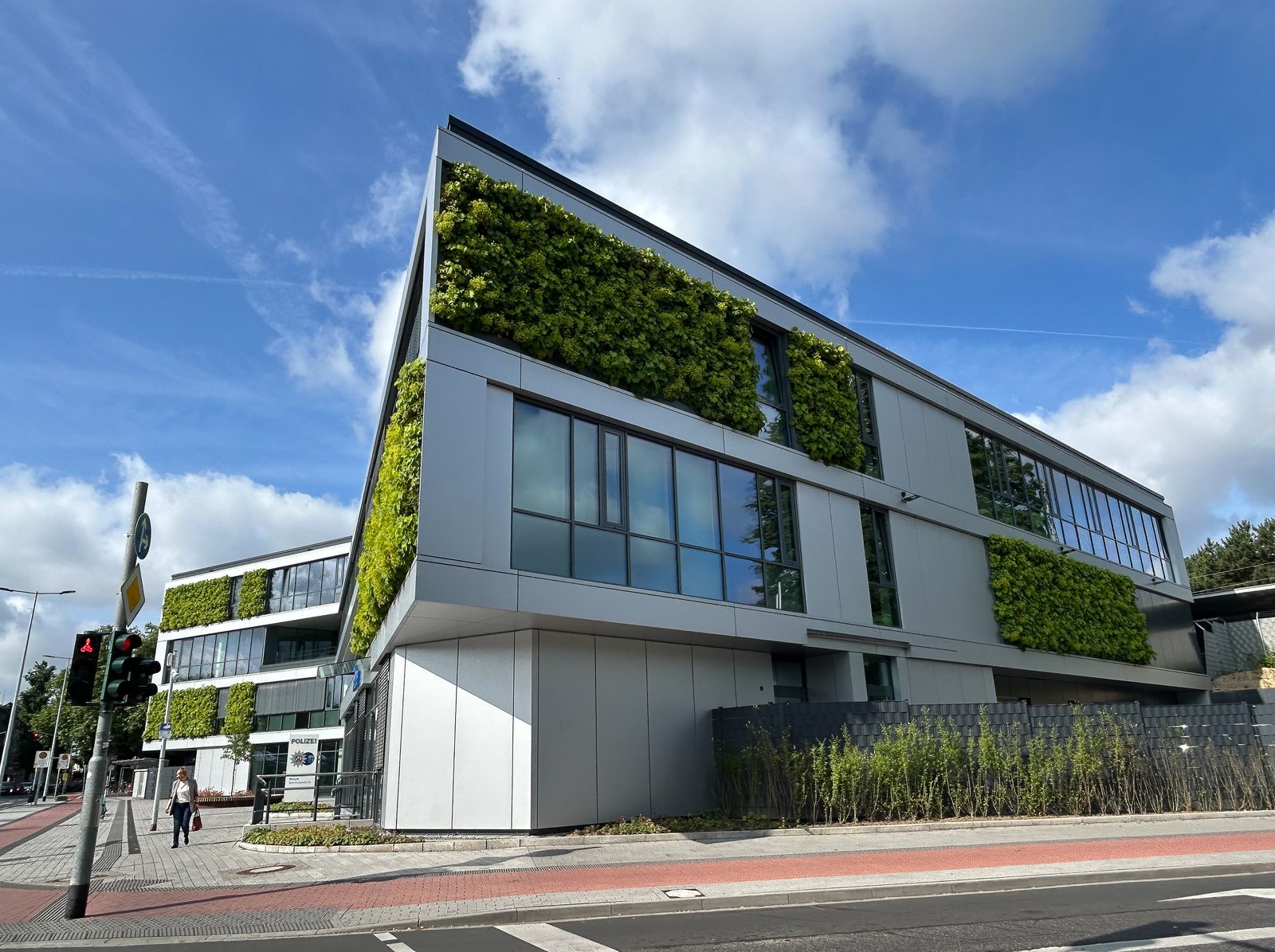
Hauptbahnhof Rheydt – fully green from handover

Green that takes years

A facade waiting for its green: ground-bound greening usually reaches the desired coverage only after more than three years.² The building has been handed over, the effect has not. Until then, the greening remains a promise.

LivingPANELS: pre-grown for 8 to 10 weeks, fully green from day one – impact and appearance from handover.

Fully grown module being hooked in

Weeks on the scaffolding

Weeks on the scaffolding and risk on site: every week of standing time costs money,³ and a leak that is only noticed after mounting means rework while the scaffolding stays up.

LivingPANELS: plug & play in three steps, leak test of the irrigation before mounting, pads removable and reusable.

¹ Trial series “Begrünte Fassadenkacheln” (STFI Chemnitz / Hochschule Geisenheim, 2017–2019), NEUE LANDSCHAFT 12/2021: loss of almost 60 % of the plants after late frost 02/2018, 20 % in the following winter. · ² City of Vienna facade greening guide, system overview: time to full greening ground-bound “after more than 3 years”, wall-bound fully green “immediately”. · ³ Indicative scaffolding rental €0.50–1.50/m² per week plus assembly/dismantling (industry benchmarks 2026). General market values, not system-specific.

Key figures

All the numbers at a glance.

All values from the home and product pages collected in one place – system, measured impact and references. For tenders, planning and comparison.

System & technology

Module size800 × 500 mm (0.4 m²) · 2.5 modules per m²
Plantingapprox. 50 plants per m², around 1 litre of root space per plant
Vegetation carriermineral-bound, dimensionally stable, over 45 % water retention per litre of substrate
Total weightbelow 50 kg/m² (fully water-saturated), usually without additional structural measures
Reaction to fireB-s1,d0 according to EN 13501-1:2018
StandardsÖNORM L1136 (AT) · FLL guideline (DE)
Irrigationsensor-controlled on demand, drippers 1.6 l/h every 20 cm, frost protection, remote monitoring
Water consumptionbelow 1 m³ per m² and year
Pre-cultivation8–10 weeks, fully green from day one
Maintenanceas a rule 1 maintenance visit per year
Insulation effect (hot box)U-value 0.72 W/(m²·K) planted & rear-ventilated – around 13 % better than the ungreened wall (0.83); measured insulation effect, not an energy certificate value
Constructionhigh-strength aluminium/steel, corrosion-protected, stainless steel; rear-ventilated
Developmentover 15 years of research & development, including with BOKU Vienna

Measured impact (HEDWIG project, Wien Energie Simmering)

Air temperatureup to 5.6 °C cooler air at the greening (daytime); around 2.5 °C on average during the 2025 heatwave
Solar radiation88–90 % less behind the greening (June/July 2024), up to 98 % during the 2025 heatwave
Surface temperature9–16 °C cooler than sheet metal, masonry or window frames (infrared measurement)
Evapotranspirationaround 129 ml per m²·h; 3–5 l per m² and day in high summer (HEDWIG, MARGRET) – draws heat from the surrounding air (equivalent to 2–3 kWh per m² and day)
Leaf coverage96–99 % projected coverage

References

Completed19 projects, around 2,800 m² in Austria & Germany
AwardBuGG Gebäudegrün des Jahres 2025 · 2nd place (Hauptbahnhof Rheydt)
Wiener Linien LängenfeldgasseVienna · 492 m² · 2025
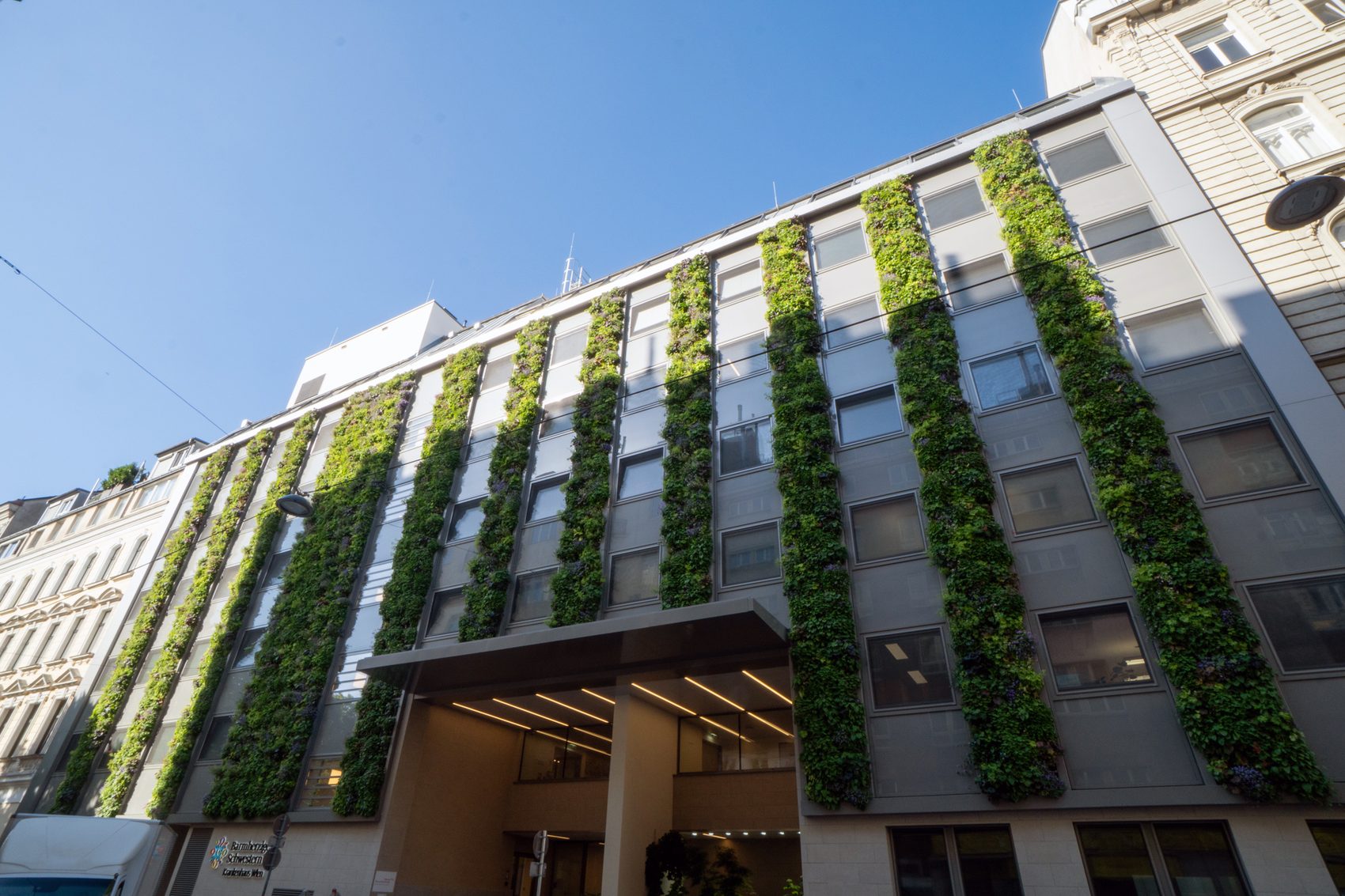
Barmherzige SchwesternVienna · 260.7 m² · 2024
Hauptbahnhof RheydtMönchengladbach (DE) · 195 m² · 2024
Wien Energie DonaustadtVienna · 147.5 m² · 2022
Cold storage logistics TKLVienna · 144 m² · 2023
Mittelpunktbibliothek BerlinBerlin (DE) · approx. 140 m² · 2025
Wagramer Straße 64Vienna · 106 m² · 2025
PenederFraham (Upper Austria) · 80.8 m² · 2022
GPA WienVienna · 59.6 m² · 2024
Wien Energie SimmeringVienna · 55 m² · 2021 (HEDWIG measurement site)
SeegasseVienna · 50 m² · 2023

Technical values according to NatureBase product documentation (Technical Information 02/2026). Impact values: Stangl R. et al. (2026), HEDWIG project, Berichte aus Energie- und Umweltforschung 59a/59b/2026, BMIMI – depend on location and building. Insulation effect from hot-box measurement. Project areas according to the NatureBase project list.

Technical details → All projects →

Current funding

Facade greening is subsidised.

Federal, state and many municipal programmes support building greening – some with fixed amounts per m², some as a bonus within housing subsidies. The Funding Check shows in 30 seconds what may apply to your project.

up to €10,000Vienna – MA 22, up to €100/m² (street-facing)
up to €15,000Linz – €550/m² wall-bound, max. 30 % of costs
up to €7,000Graz – up to 70 % of construction costs
€120/m²Federal (KPC) – facade-bound greening with comprehensive renovation
Funding Check

Which funding suits your project?

?

Select location, applicant and area – the matching programmes appear here with an indicative amount and a link to the funding body.

Vienna · up to €100/m²Linz · €550/m²Graz · up to 70 %Hamburg · up to 60 %Cologne · 50 %

The Funding Check is non-binding guidance (as of October 2026) and does not replace a funding commitment. Indicative amounts are calculated from the published funding rates; the actual amount depends on costs, guidelines and the budget of the funding body. Basic rule of almost all programmes: submit the application before awarding the contract. Combining programmes is usually permitted up to 100 % of costs.

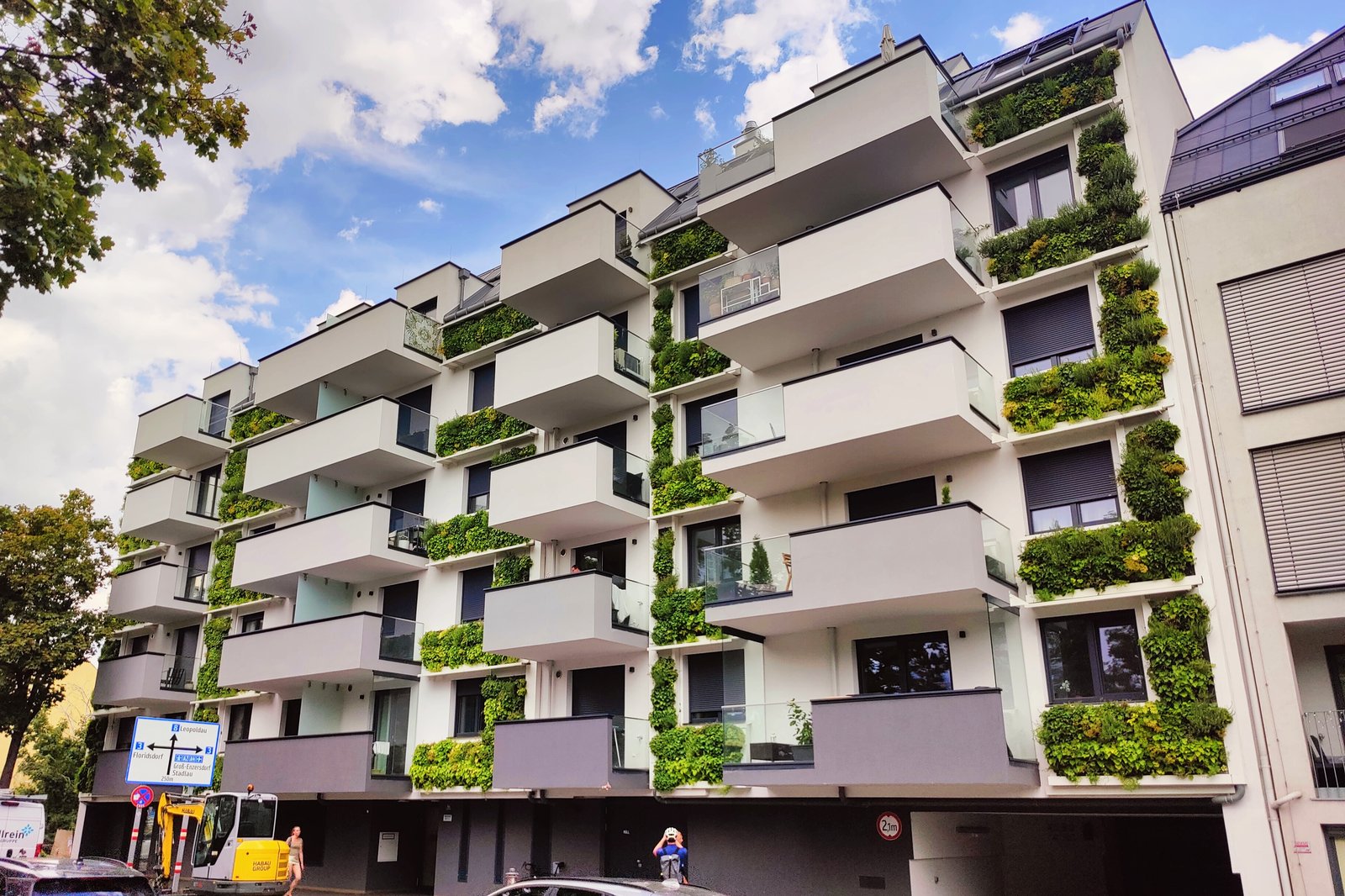
Street-facing greened residential building Wagramer Straße, ViennaVienna: street-facing greening is subsidised with up to €100/m²
Mittelpunktbibliothek Berlin with green facadeGermany: over 100 cities fund building greening

Overview by region

Federal – Umweltförderung (KPC)

For businesses and municipalities: roof and facade greening as part of a comprehensive thermal renovation – €120/m² facade-bound, €60/m² ground-bound, €18/m² roof (municipalities 60 % of these rates). Not as a stand-alone measure. Private: greening bonus with thermal renovation.

umweltfoerderung.at →

Vienna – MA 22

Street-facing facade greening: up to €100/m², max. €10,000 per property; on private property max. €5,000; roof greening up to €30,000; de-sealing & greening up to €200/m². Not for public bodies; 15-year maintenance obligation; ÖNORM L1136. Exhausted for 2026, applications from early 2027.

wien.gv.at →

Graz

Facade greening up to 70 % of construction costs, max. €7,000 per building; roof greening up to 50 %, max. €10,000 (existing buildings). The “Grün vor der Haustür” programme is aimed at private applicants.

graz.at →

Linz

Wall-bound facade greening €550/m², max. 30 % of total costs or €15,000; from 20 m², at least two plant genera, specialist contractor. Ground-bound €150/m² (max. €4,500), roof €15/m² (max. €7,500).

linz.at →

Lower Austria

Municipal programmes in Mödling and Wieselburg, among others (roof and facade greening). Greening earns eco-points in the Lower Austrian housing subsidy scheme; subsidised ecological business consulting for companies.

Mödling → · Wieselburg →

Upper Austria & Vorarlberg

Upper Austria: Traun funds facade greening; GeKAP covers municipal buildings in Climate Alliance municipalities. Vorarlberg: numerous municipalities (Bregenz, Feldkirch, Hohenems, Götzis and others) fund building greening – overview at the Energieinstitut.

energieinstitut.at →

State housing subsidies

Roof and facade greening counts as a bonus or eligible measure in new builds and renovations in Carinthia, Tyrol, Burgenland and Lower Austria; in Vienna via wohnfonds_wien as part of comprehensive renovations.

GRÜNSTATTGRAU overview →

Germany

No federal funding for facade greening – support is municipal: Hamburg up to 60 % (max. €100,000), Frankfurt 50 % (max. €50,000), Düsseldorf 50 % (max. €25,000), Cologne 50 % (max. €20,000), Bochum, Dortmund, Mannheim, Nuremberg and many more. For municipalities: federal programme “Anpassung urbaner Räume an den Klimawandel” up to 85 %. The Funding Check above covers the most important cities; all others via the funding check of our partner Küster Grün.Stadt.Klima.

Funding check Germany (KGSK) → · BuGG funding list →

As of October 2026. Funding amounts and conditions change – please check officially before applying. Sources: City of Vienna (MA 22) · City of Graz · City of Linz · Federal Umweltförderung (KPC, info sheet 07/2026) · BuGG city list (as of 11/2025) · Hamburg BUKEA/IFB · GRÜNSTATTGRAU · DIE UMWELTBERATUNG

By role

What matters in your project phase.

Planning, development and operation ask different questions of a green facade. Here you will find the key answers in one place.

Planning basis: module in cross-sectionArchitecture & planning

As plannable as a facade.

  • Fixed module grid 800 × 500 mm, adaptation to the wall via special pads
  • Reaction to fire B-s1,d0 according to EN 13501-1, planning basis ÖNORM L1136 or FLL
  • Rear-ventilated and hung in front of the wall, no root pressure on the facade
  • Use on flat, vertical surfaces (not inclined, not curved)
  • Distance to window glass: min. 50 cm recommended, check per project
Residential building Wagramer Straße – green at handoverProject development & property developers

Calculable early, visible immediately.

  • Below 50 kg/m², on many existing facades without major additional structural measures
  • No ground connection needed: above underground car parks, on fire walls, in dense development
  • Fully green from handover, no waiting for growth
  • Pre-cultivation 8–10 weeks, total lead time longer: plan early
  • Measured impact as an argument: up to −5.6 °C cooler air (HEDWIG), U-value 0.72 W/(m²·K) in the hot-box test
  • Funding possible in Vienna, Graz and at federal level
Wien Energie Simmering – in operation and monitored since 2021Building owners & operators

Little effort in operation.

  • As a rule one maintenance visit per year
  • Sensor-controlled irrigation on demand, below 1 m³ of water per m² and year
  • Technical monitoring as a package from NatureBase: consumption tracking and remote fault detection
  • Maintenance via maintenance partner with its own maintenance contract
  • Winter-hardy selection of perennials, green throughout the seasons
  • Modules individually replaceable, removable and reusable on dismantling
Frequently asked questions

Everything you need to know about facade greening.

Basics

What is vertical facade greening?

The permanent planting of a building wall. Ground-bound systems use climbing plants rooted in the soil; wall-bound systems such as LivingPANELS carry the plants in a vegetation carrier mounted on the wall – fully green from the start.

What are LivingPANELS?

A modular, wall-bound system from Austria. The modules (800 × 500 mm, approx. 50 plants/m²) are pre-grown for 8–10 weeks, arrive at the site fully green and are hooked in using a plug & play process.

Why are facades ideal for greening?

Facades make up the largest surfaces in the city and – unlike trees or open spaces – do not compete for land or use. They are therefore well suited to greening dense urban areas on a large scale.

Impact & urban climate

How do green facades cool?

Through evapotranspiration and shading. At the Wien Energie Simmering reference site, the HEDWIG project (BOKU/IBO, 2024–2025) measured air up to 5.6 °C cooler behind the greening, and around 2.5 °C on average during the 2025 heatwave. Values depend on location and building.

How much is solar radiation reduced?

At the Simmering reference site, 88–90 % less solar radiation was measured behind the greening (June/July 2024), and up to 98 % during the 2025 heatwave. The surface of the greening was 9–16 °C cooler than inert materials such as sheet metal, masonry or window frames (infrared measurement).

How much water does a green facade evaporate?

The actively irrigated, wall-bound planting evaporates 3–5 litres of water per m² and day in high summer (HEDWIG, MARGRET) – this evapotranspiration draws heat from the surrounding air (equivalent to 2–3 kWh of cooling capacity per m² and day). Over the year, water consumption stays below 1 m³ per m² thanks to sensor-controlled irrigation. Source: HEDWIG project, Simmering reference site, depends on location and building.

Does a green facade support biodiversity?

The diverse planting of perennials and flowering plants provides food for insects. The plant selection is tailored to location and exposure.

Technology & operation

How heavy is a LivingPANELS facade?

In lightweight construction below 50 kg per m² (fully water-saturated). This usually means no additional structural measures are required; the assessment is carried out for each building.

Are LivingPANELS winter-hardy?

Yes. The mineral-bound vegetation carrier and a winter-hardy selection of perennials keep the facade green throughout the seasons. Professional maintenance and occasional replanting are part of normal operation.

How much water and maintenance are needed?

Water consumption is below 1 m³ per m² and year, sensor-controlled on demand with frost protection and remote monitoring. As a rule, one maintenance visit per year is sufficient.

What is the reaction to fire of LivingPANELS?

Classified B-s1,d0 according to EN 13501-1; s1 stands for the lowest smoke production class. For special requirements, the solution is coordinated based on the protection objective.

Is the system suitable for new builds and existing buildings?

Yes. The complete system including system terminations is suitable for both and is installed as a rear-ventilated facade using a plug & play process.

Which standards is planning based on?

In Austria according to ÖNORM L1136, in Germany according to the FLL guideline. Reaction to fire is classified according to EN 13501-1.

Costs, funding & process

How much does a green facade cost?

Costs depend on area, geometry, substructure and execution. We prepare a binding quotation for each individual building.

What funding is available?

Vienna (MA 22): up to €100/m², max. €10,000 per property (currently exhausted, next period ~2027). Graz: up to 70 % of construction costs, max. €7,000. Nationwide: Umweltförderung im Inland (KPC). As of September 2026 – please check officially before applying.

How does a project proceed?

In four steps: planning & plant selection, pre-cultivation (8–10 weeks), plug & play installation, operation with demand-based irrigation and remote maintenance.

How do I start my project?

The easiest way is via our contact form. We advise on the system, plant selection, funding and implementation.

Advice

Still have questions about facade greening?

We are happy to share our knowledge – from funding to technical implementation.